
As conversations about redesigning education grow louder (which I am here for!) and the immediate pressures feel complex and overwhelming, one idea keeps surfacing:
“Students don’t need to spend as much time in school.”
I understand the instinct.
When attendance is declining, engagement is dropping, and technology allows learning to happen anywhere, many people assume the solution is simply less seat time.
I found myself asking a different question:
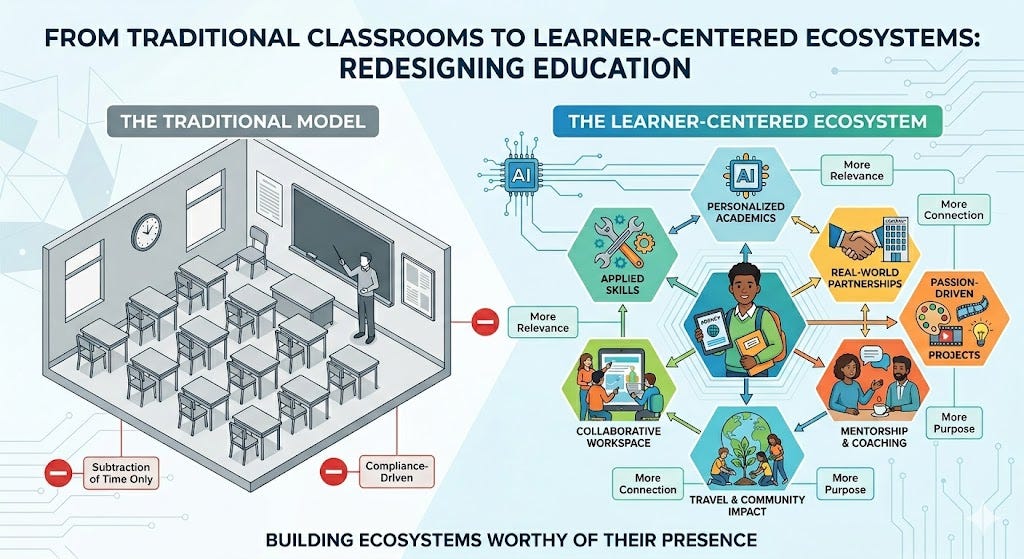
If students spend less time in traditional classrooms, what are we building in its place?
Because the future of education cannot simply be about reducing time in school.
It must be about creating something better.
Redesign Requires Imagination, Not Just Subtraction
New school models like Alpha are getting a lot of attention for their AI-powered “2-hour learning model,” but the two hours of personalized academic instruction are actually the least interesting part of the story from my perspective. The real innovation is what those two hours make possible for the rest of a young person’s day.
We’ve had online courses, credit recovery programs, and self-paced virtual schools for years. Students moving through content independently is not new. What matters is what schools intentionally design around that efficiency.
Too often, when students finish academics quickly, we simply give them more free time and hope they use it well. Some do. Elite athletes can train. Some teenagers work to support their families. But many young people are left without meaningful structures, mentorship, or opportunities that help them build purpose, relationships, and real-world skills.
The promise of models like Alpha is not that AI can replace teachers or compress academics into two hours. The promise is that technology can free up time for experiences that traditional schools have struggled to prioritize: internships, entrepreneurship, collaborative projects, community impact, mentorship, passion-driven learning, travel, apprenticeships, wellness, and deeper human connection.
If we only focus on the efficiency of the academic model, we miss the bigger question: What experience should young people have to launch them into life, work, and citizenship as young adults and beyond?
The future of education is not about getting through content faster. Information has already become abundant and accessible. The real challenge is helping young people discover who they are, how they contribute, how they work with others, and how they navigate an unpredictable world.
Redesign requires more than subtraction.
It requires imagination.
Young people still need and want structure, guidance, mentorship, accountability, challenge, and community. They still need caring adults who know them well. They still need opportunities to develop skills, identity, confidence, and purpose.
What needs to change is not the importance of learning.
What needs to change is what and how we learn, and the design of the ecosystem surrounding it.
Designing Education Ecosystems
The schools emerging from the most forward-thinking design conversations are not abandoning learning. They are expanding where, how, and with whom learning happens.
They are moving beyond the idea that education only occurs inside classrooms between bells.
Instead, they are building learner-centered ecosystems.
Ecosystems where students learn across schools, workplaces, community organizations, studios, civic spaces, athletic programs, and digital environments.
Ecosystems where students are accountable not only for academic credits, but also for internships, mentorships, community impact, collaboration, creative work, and real-world problem solving.
Ecosystems where learning feels connected to life.
During the Liftoff Design Sprint, we intentionally brought together youth, educators, entrepreneurs, human development specialists, and technologists to design future models that prepare young people to thrive in life, work, and democracy.
Several key shifts are beginning to define these emerging models.
1. Relationships become the foundation.
In many traditional systems, students can move through an entire school day without being deeply known by a single adult. Redesigned models prioritize advisory systems, mentorship, coaching, and smaller learning communities where students build meaningful relationships with adults who support both their academic and personal growth.
2. Learner agency becomes central within a community of support.
For too long, students have experienced school as something done to them rather than something they actively shape. Redesigned models recognize that young people develop confidence, motivation, and purpose when they have meaningful voice, choice, and ownership over their learning. Students increasingly help set goals, make decisions about how they learn, pursue personal interests, and contribute to real work that matters.
But agency does not mean isolation or unlimited independence. Young people still need structure, guidance, accountability, and belonging. The strongest models balance autonomy with community—creating environments where students are known, supported, challenged, and connected to others. Learners develop agency not by navigating everything alone, but by participating in collaborative communities where they learn to lead, contribute, communicate, and take responsibility alongside peers and mentors.
3. Learning becomes more flexible and personalized.
Instead of assuming all students learn the same thing, at the same pace, in the same way, schools are beginning to create competency-based pathways focused on mastery and growth. AI and technology can help personalize foundational instruction, freeing educators to spend more time on mentorship, feedback, collaboration, and deeper learning experiences.
4. Learning becomes more authentic.
Students increasingly want work that feels meaningful and connected to the real world. Internships, client-connected projects, entrepreneurship, civic engagement, design challenges, and community partnerships allow students to apply skills in meaningful contexts rather than simply completing disconnected assignments.
The most powerful learning opportunities often exist beyond school walls. Businesses, nonprofits, universities, libraries, museums, and community organizations can become active partners in learning—not occasional add-ons, but integrated parts of the educational experience.
5. Success gets redefined.
For generations, success in school has largely been measured through grades, credits, and test scores. But in a world where AI can increasingly replicate routine cognitive tasks, human strengths matter more than ever: creativity, communication, collaboration, adaptability, ethical decision-making, curiosity, resilience, and purpose.
Redesigned systems recognize that transcripts alone are no longer enough to capture the fullness of a learner’s growth. Digital portfolios, exhibitions, public demonstrations of learning, and competency-based evidence provide richer ways for students to show what they know and who they are becoming.
This shift moves schools away from compliance-driven systems toward cultures where students are active participants in their growth, capable of directing their learning while understanding their role within a larger community.
6. The role of the educator shifts.
The one teacher to a class of 35 students is not set up for the four shifts above. A caseload of 150-200 youth does not allow 1 teacher to build meaningful relationships with them, mentor them, or personalize their learning. Educators, like all humans, have strengths and challenges in their roles, and we will get the best of everyone when we design for educators to collaborate to better serve young people in teams, not around courses and bell schedules.
Centering Learners By Design
Most importantly, these emerging models recognize something essential:
Learning is deeply human.
Technology can personalize content. AI can accelerate access to information. But no algorithm should replace belonging, mentorship, encouragement, or human connection.
The real opportunity before us is not simply to modernize school.
It is to redesign learning around what young people actually need to thrive in a rapidly changing world.
Not less accountability.
Not less rigor.
But more relevance.
More connection.
More purpose.
More opportunities for students to contribute meaningfully to the world around them.
Because if we want students to fully show up—in school and in life—we must create ecosystems worthy of their presence.

0 Comments