
Almost every day, I get a text from my daughter:
“Mom, can you sign me out of school?”
I know we are not alone.
I hear similar stories from parents across the country. I see it all over social media. I hear it directly from educators. My daughter told me that by the end of the year, only 11 of the 35 students in one of her classes were showing up consistently. Principals tell me attendance is worse than they have ever seen it. The data confirms that.
“Kids are leaving for appointments, sports, travel, illness, or just staying home more than ever,” one principal shared with me. And honestly, many families admit that they no longer see school attendance as essential in the way they once did.
Schools have responded in many ways: stricter attendance policies, threats to withhold prom, homecoming, or even graduation for unexcused absences. But many parents quietly admit they still sign their children out—especially when their child has good grades, as the amount of time in school no longer correlates with the grades if students can keep up with the assignments.
And that raises an uncomfortable set of questions:
If AI can complete assignments, what is the value of the work students are being asked to do?
If students are physically sitting in school but mentally disengaged, what is the value of the time they are spending there?
If students can get A’s and B’s without sitting in class every day, what is the value of seat time?
If there is rich, authentic learning happening outside of school, how do we make those opportunities more accessible?
It’s Not More, It’s Different
These questions are not an attack on teachers or schools. They are signals that something deeper is shifting beneath us.
For generations, school attendance was rarely questioned because school was the central place where learning, social life, activities, and opportunities happened. Now, students can access information instantly. They can connect socially anytime and anywhere. They can learn skills online, build audiences, start businesses, create content, and use AI tools to complete tasks faster than ever before.
At the same time, many of the experiences that once made school feel meaningful and memorable have slowly disappeared under pressure to maximize instructional minutes and improve test scores. The final weeks of school used to be filled with field days, assemblies, performances, traditions, celebrations, and rituals that brought people together. School was not only academic; it was social, emotional, and deeply communal.
Today, many students experience school as a series of disconnected assignments, compliance tasks, and performance measures.
Meanwhile, educators are trying to hold together a system under enormous strain.
Teachers are navigating rising behavioral challenges, widening academic gaps, chronic absenteeism, mental health concerns, and now the rapid emergence of artificial intelligence—all while working inside systems built for a different era. Many feel trapped between conflicting expectations: raise achievement, maintain rigor, improve attendance, personalize learning, close gaps, increase engagement, and somehow do it all with less time, fewer resources, and declining trust and support.
And AI has accelerated the tension.
The Foundation is Shifting
Students tell me their teachers are using AI to create assignments and grade work. Teachers tell me students are using AI to complete those assignments. Families still want their children to succeed, but the traditional formula—work hard, get good grades, get a stable job—no longer feels guaranteed.
Meanwhile, many assessments still prioritize memorization and compliance over critical thinking, creativity, collaboration, or authentic application. Cheating has become easier, but more importantly, the line between “doing the work” and “outsourcing the work” is becoming increasingly blurred.
These are not isolated problems.
They are warning signs that the foundations of the steady system are shifting.
For decades, schools have been organized around seat time, Carnegie units, schedules, standardized pacing, and compliance structures. Those systems created stability and consistency for generations. But technology is changing how people learn, work, communicate, and create value in the world. As that happens, the limitations of our current model are becoming harder to ignore.
This moment should not lead us to blame young people, families, or educators. It should lead us to rethink the experience we are asking students to show up for every day and the job we are asking educators to do.
Young people are not disengaging from learning. In many cases, they are disengaging from systems that no longer feel connected to their lives, identities, relationships, or futures.
Reframing the “Disengaged Teen”
One of the most important shifts we need to make is reframing how we think about disengaged teenagers. Too often, we label students as lazy, unmotivated, or apathetic when, in reality, disengagement is often a response to the system itself. The traditional high school model frequently overwhelms, exhausts, or bores students rather than nurturing their natural curiosity and strengths. My daughter, like many, would love to be in school learning and connecting with peers around work and issues that matter.
In The Disengaged Teen, researchers Jenny Anderson and Rebecca Winthrop describe four common ways students adapt to school environments. Some become Resisters—acting out, or refusing work because they feel unsuccessful or unseen. Others become Passengers—doing the bare minimum to get by because school feels disconnected from meaning or purpose. Some become Achievers—earning high grades and appearing successful externally while quietly battling anxiety, burnout, and fear of failure. And then there are Explorers—students driven by curiosity, purpose, and intrinsic motivation.
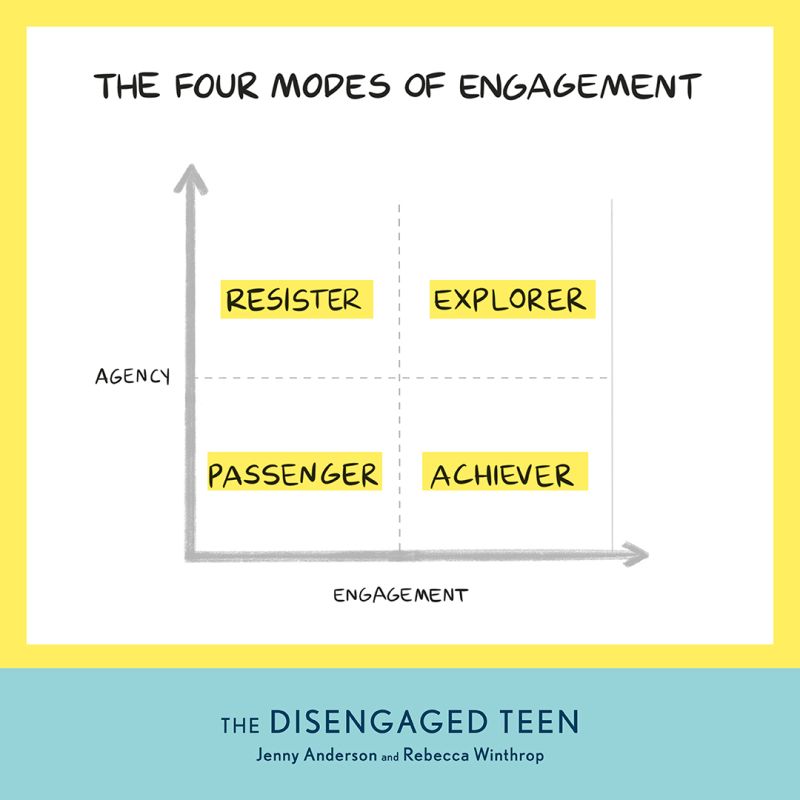
The goal is not simply to force compliance or improve attendance numbers. The goal ought to be to create learning environments that help more young people become Explorers: engaged, curious, connected, and motivated to learn because they see meaning in what they are doing.
What many are rejecting is not accountability. It is irrelevance.
The attendance crisis is not just a policy problem. It is a design problem.
And if we continue responding only with tighter rules, harsher consequences, more surveillance, and stronger compliance measures, we risk missing the deeper message students are sending us.
Young people are asking for learning environments worthy of their presence.
That is the real challenge in front of us.
And it is also the opportunity.


0 Comments